

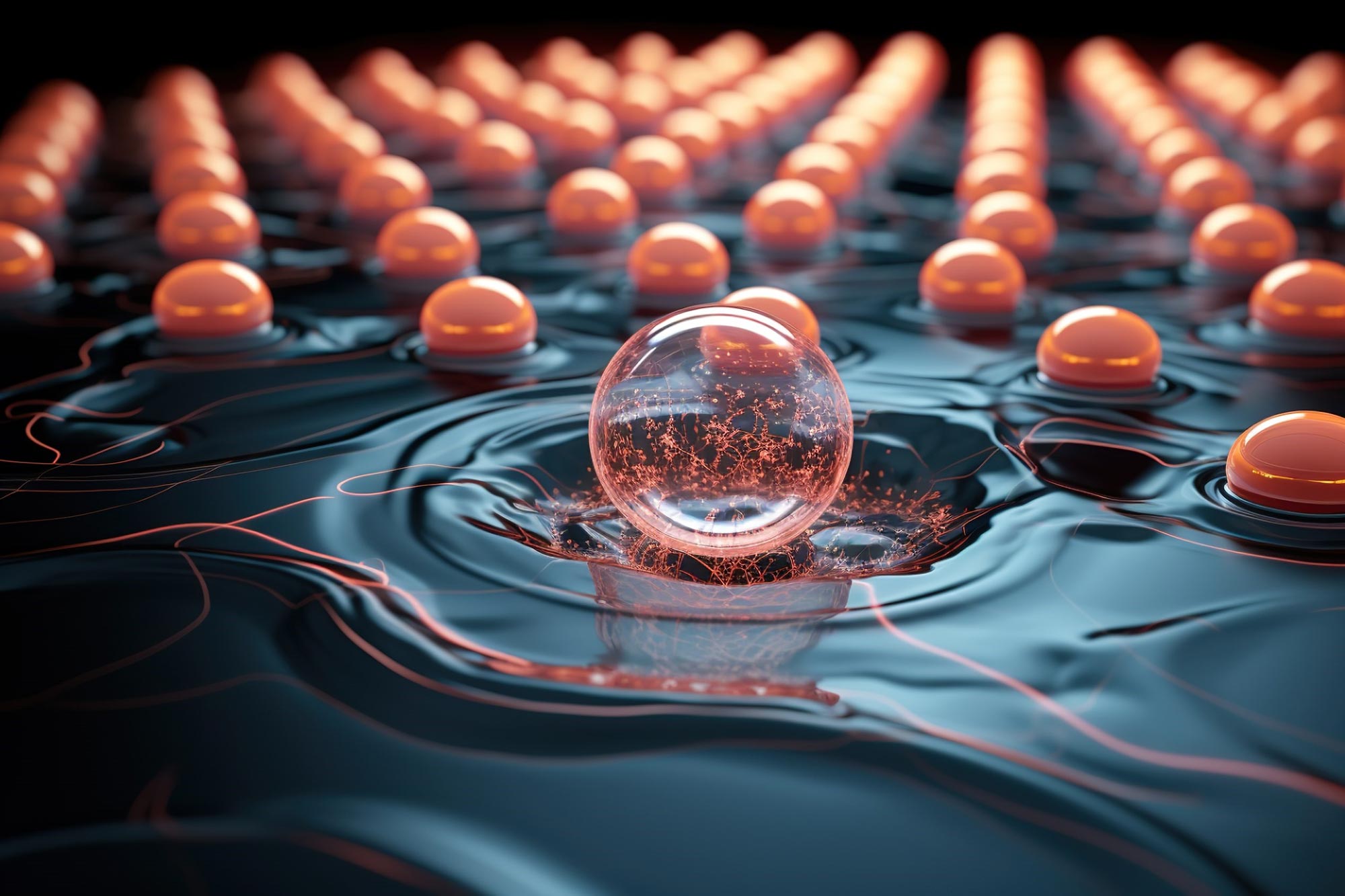

Científicos del Centro RIKEN para Ciencias de Materiales Emergentes han inventado un material compuesto que transmite energía mecánica en una dirección específica. Este hidrogel con nanomateriales integrados podría revolucionar la forma en que se utiliza la energía vibratoria derrochadora.
Un grupo de investigación dirigido por científicos del Centro RIKEN de Ciencias de Materiales Emergentes ha desarrollado un material único, basado en nanorrellenos incrustados en un hidrogel, que puede dirigir la energía mecánica en una dirección pero no en la otra, y operar de forma «no recíproca». manera. Con los compuestos, que se pueden construir en diferentes tamaños, el equipo pudo usar movimientos vibratorios hacia arriba y hacia abajo para hacer que las gotas de líquido se elevaran dentro del material. Por lo tanto, el uso del material puede hacer posible el uso útil de vibraciones aleatorias para mover el material en la dirección preferida.
Canalizar la energía en una dirección preferida es una característica importante que realmente hace posible la vida. muchas funciones biológicas básicas como[{» attribute=»»>photosynthesis and cellular respiration are made possible by channeling random fluctuations in nature in a nonreciprocal way, to drive a system away from entropy, like the famed Maxwell’s demon. Devices that allow energy to move preferentially are used in many areas, such as electricity, where they allow AC current to be transformed into DC current, as well as in photonics, magnetism, and sound. However, it has proven more difficult to create devices that channel mechanical energy, which could also have many potential uses.

Hydrogel for channeling mechanical energy in a preferred direction. Credit: RIKEN
Now, a RIKEN-led group has developed a remarkable but uniform material that can is relatively easy to produce and which can perform this function. To create it, the group used a hydrogel—a soft material made mainly of water—made of a polyacrylamide network and embedded graphene oxide nanofillers into it, at an angle. The hydrogel is fixed to the floor, so that the top part can move when subjected to a shear force but not the bottom. And the fillers are set at an angle, so that they were angled clockwise from top to bottom.
When a shear force is applied toward the left, from the direction the nanofillers are leaning, they tend to buckle and hence lose their resistance. But in the other direction, where they are facing away from the force, the applied shear merely makes them stretch even longer, and they maintain their strength. This allows the sheet to deform in one direction but not the other, and in fact the group measured this difference, finding that the material was approximately 60 times as resistant in one direction than the other.

Application of the hydrogel for anti-gravity transport of water droplets. Credit: RIKEN
As an experiment to demonstrate what this could actually do, they created a block of the material and placed it on a vibrating stand. Depending on the way it was designed and oriented the material was able to channel through the material to make droplets move to the right or left, or even upward through the network but not downward. They could also use the vibrational motion to drive a circular motion that could be controlled to be either clockwise or anticlockwise. In the case of vertical orientation, when drops of colored liquid were injected into the hydrogel, they moved upward as if by magic, with the alternating vibrational movements, which are usually not of any use, being channeled to create net motion.
Finally, as a further test, the group, in collaboration with researchers from the RIKEN Hakubi Fellows program, place C. elegans worms on the material, and though their movements are normally random, they ended up all moving to one or another side of the hydrogel, depending on its orientation.
According to Yasuhiro Ishida of the RIKEN Center for Emergent Matter Science who led the work, “It was a remarkable and surprising result, seeing how mechanical energy could be channeled in one direction preferably, in such a clear way, and using a material that is rather easy to make and quite scalable. In the future, we plan to find applications for this material, with the hope that we can use it to make effective use of vibrational energy that, up until now, has been seen as waste.”
Reference: “Mechanical nonreciprocity in a uniform composite material” by Xiang Wang, Zhihao Li, Shuxu Wang, Koki Sano, Zhifang Sun, Zhenhua Shao, Asuka Takeishi, Seishiro Matsubara, Dai Okumura, Nobuyuki Sakai, Takayoshi Sasaki, Takuzo Aida and Yasuhiro Ishida, 13 April 2023, Science.
DOI: 10.1126/science.adf1206

Javier Marías es colaborador en El Demócrata, donde cubre temas de actualidad, política, negocios, tecnología, deportes, entretenimiento y estilo de vida. Su trabajo se centra en ofrecer información clara, útil y bien contextualizada, acercando a los lectores noticias, tendencias y acontecimientos relevantes para comprender mejor el mundo que los rodea.